Adjusting Your Boundaries Without Losing Trust in Yourself
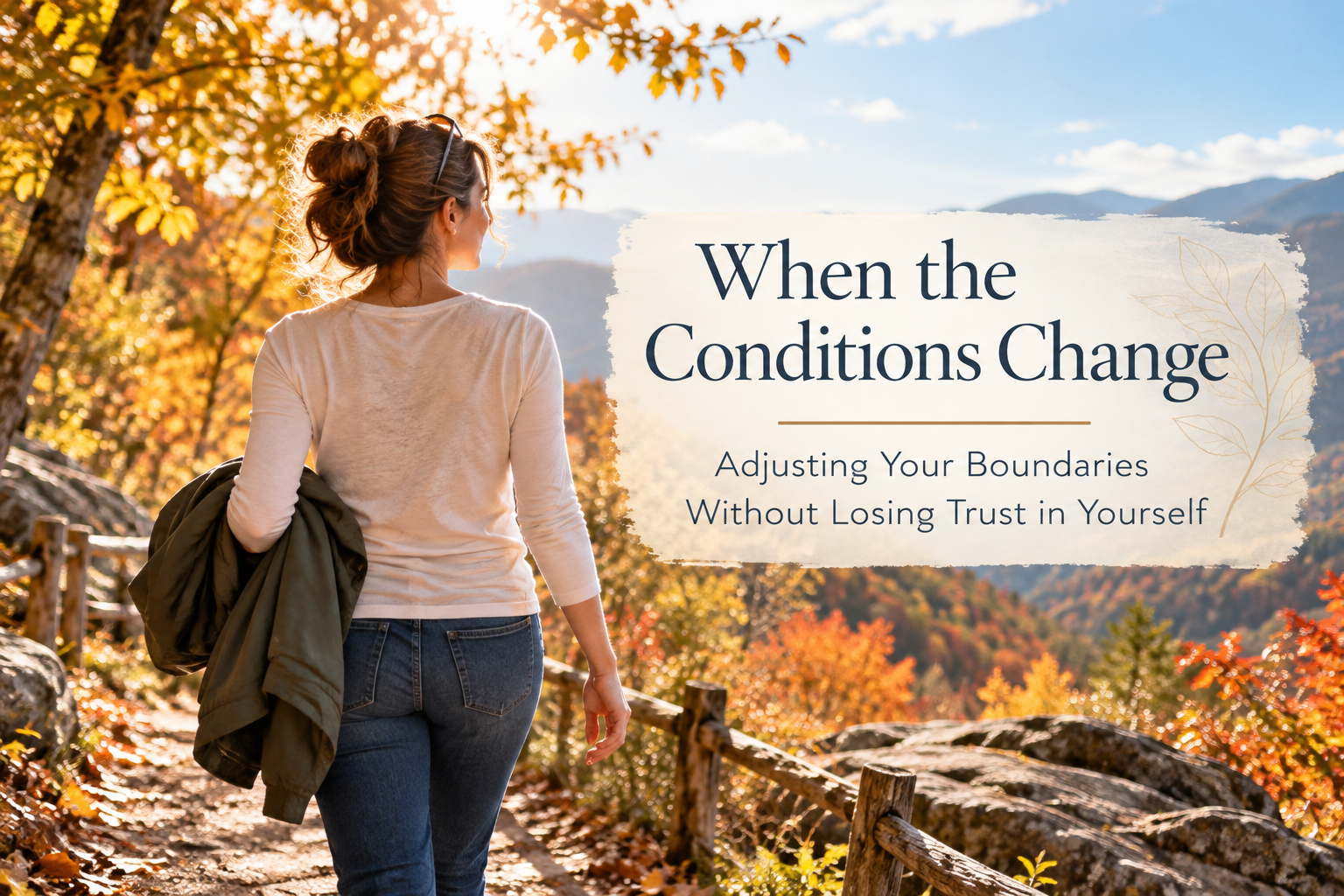
Fall Has a Way of Keeping Us Guessing
Fall in North Carolina can require a certain amount of flexibility.
You step outside in the morning and it feels like winter has arrived overnight. You grab a sweater, maybe a jacket, and congratulate yourself for finally remembering that summer is over.
Then the afternoon arrives.
Suddenly, it feels like summer again, the jacket is draped over your arm, and you're wondering why you bothered bringing it in the first place.
And anything that happens between morning and afternoon can sometimes feel like anyone's guess.
There is something interesting about the way we respond to these changing conditions.
We adjust.
We add a layer when we're cold. We take one off when we're warm. We might bring the jacket along even when we aren't sure we'll need it.
At any given moment, there is another opportunity to notice the conditions and decide what level of protection is going to feel comfortable.
We don't usually interpret that adjustment as failure.
Taking off the jacket at two o'clock doesn't mean putting it on at eight o'clock was a mistake.
The conditions changed.
So we adjusted.
What if we could give ourselves some of that same flexibility when the conditions around our boundaries change?
For women with ADHD, adjusting a boundary can sometimes be more complicated than simply noticing that circumstances have changed. When years of second-guessing yourself are already part of the picture, needing to change course can quickly begin to feel like evidence that you got something wrong.
Some Changes Are Harder to Adjust To
Of course, not every change feels as manageable as deciding whether to wear a jacket.
Some changes give us plenty of warning.
We can see them coming. We have time to think about what we might need, gather our resources, and prepare ourselves for what's ahead.
Other changes are maddeningly blindsiding.
Something that felt dependable suddenly isn't.
A relationship changes.
An expectation shifts.
Someone responds in a way you didn't anticipate.
A workplace changes the rules.
A routine that had been keeping things together no longer works.
Or maybe you have poured blood, sweat, tears, thought, planning, and energy into building a system that finally seemed to make life a little more manageable—only to watch circumstances change and that system begin to crumble right before your eyes.
When that happens, it can be difficult to separate what changed around us from what we start believing about ourselves.
Did I get this wrong?
What did I miss?
Why didn't I see this coming?
Was the whole thing flawed from the beginning?
Can I trust my own judgment?
For women with ADHD who have spent years hearing some version of you should have known, you should have remembered, you should have tried harder, an unexpected change can carry more than the inconvenience of having to adjust.
It can awaken an old fear that needing to adjust means you got it wrong.
And before long, one changing circumstance can become a whirlwind of self-doubt.
You Don't Have to Decide What It Means Yet
This is one of the reasons I've been thinking so much about boundaries as more than simply saying yes or saying no.
Sometimes a boundary gives us somewhere to pause.
In previous posts, I've talked about imagining a boundary around your internal space and even creating a little mailbox—or what I sometimes think of as a grain-of-salt space—along its edge.
It's a place for the things other people hand us that we haven't made our minds up about yet.
An expectation.
A suggestion.
An opinion.
A request.
A criticism.
An invitation.
A "should."
Something can be presented to you without automatically becoming yours.
You don't necessarily have to reject it, either.
You can put it in the mailbox.
You can give yourself permission to say, in one form or another:
I'm going to hold onto this long enough to think about it.
That pause becomes especially important when circumstances change unexpectedly.
Because you don't necessarily have to decide, while you're still standing in the whirlwind, what the change says about you, your choices, or everything you've built.
First, you can give yourself somewhere to put it.
Then, when you're ready, you can begin to sort.
Sometimes We Need to Sort the Salt
Imagine having one of those experiences that simply rubs you the wrong way.
You might know immediately:
I didn't like that.
But you may have a much harder time answering:
What exactly didn't I like about it?
Sometimes the whole experience gets bundled together into one giant YUCK.
This is where I've found it helpful to slow things down and begin separating the ingredients.
I sometimes think of this process as sorting the salt.
Instead of requiring yourself to decide whether the entire experience was good or bad, right or wrong, helpful or unhelpful, you begin noticing its individual pieces.
There might have been something about the person's tone that didn't sit well with you.
Maybe there was an assumption being made about what you would do.
Maybe the timing felt impossible.
Maybe the idea itself was actually pretty good.
Maybe you wanted to help, but not in the way you were being asked to help.
Maybe part of what happened reminded you of an older experience and carried more emotional charge than you expected.
Maybe something simply felt off, even though you can't quite explain why yet.
Some pieces might fit.
Some might not.
Some might belong to someone else.
And some might need more time before you know what you think about them.
You don't have to make one decision about the entire pile.
You can sort.
And sometimes sorting helps us discover that the whole thing doesn't need to be thrown away.
When an experience has been painful, disappointing, or simply hasn't worked the way we expected, it can be tempting to question all of it. Separating the pieces gives us a chance to notice what is still working, too.
Maybe the whole system didn't fail. Maybe one part needs adjusting.
Maybe the relationship isn't entirely broken. Maybe something happened that needs repair.
Maybe the boundary itself isn't wrong. Maybe the conditions around it changed.
Pausing long enough to sort can leave room for repair where repair is possible—without asking us to pretend that the pieces that didn't work were okay.
Sometimes what needs changing is only one part of something we still value.
And sometimes, once we've separated that part from the whole, we can begin asking a different question:
If this isn't what I wanted, what would I have wanted instead?
What Doesn't Fit Can Help You Discover What Does
That question can shift the focus from simply identifying what went wrong to noticing what the experience might be teaching you about yourself.
Maybe you didn't want someone making the decision for you.
Perhaps what you wanted was to be asked.
Maybe you didn't want the request arriving with an assumption that you would say yes.
Perhaps what you wanted was room to consider it before answering.
Maybe you didn't like the way feedback was delivered.
Perhaps what you wanted was directness with kindness. More context. A private conversation. An opportunity to ask questions.
The things that don't fit can begin giving us information about the things that do.
Preferences.
Needs.
Values.
Limits.
Communication.
Pace.
Connection.
Distance.
Protection.
Choice.
And little by little, what began as one big something about that didn't feel right can become a clearer picture of what actually does feel right for you.
The goal isn't necessarily to construct a list of everything you will never tolerate again.
It's to become increasingly familiar with yourself.
This works for me.
This doesn't.
I could do this, but not that.
I need more time.
I changed my mind.
I don't know yet.
This part is important to me.
Those distinctions can be difficult to hear when everything is mixed together.
Sorting gives them some room to become visible.
And the more visible they become, the more information you have when it's time to decide whether something needs to be repaired, released, protected, approached differently—or simply adjusted to fit the conditions you're standing in now.
Changing the Boundary Doesn't Mean You Got It Wrong
And that brings us back to the jacket.
The jacket might have been exactly what you needed this morning.
Taking it off this afternoon doesn't make that untrue.
And putting it back on when the sun goes down doesn't mean you were wrong to take it off.
Each choice can make sense within the conditions in which you made it.
Our boundaries can work that way, too.
Something that protected you during one season of your life may need to change during another.
A system that worked beautifully under one set of circumstances may need adjusting when the circumstances change.
You may discover that you need more protection in one relationship and less in another.
You may need more time before answering than you used to give yourself.
Or you may discover that something you once needed to hold at a distance no longer feels quite so threatening.
Adjusting doesn't automatically mean the original boundary was wrong.
And encountering conditions you couldn't predict doesn't mean you failed to prepare.
Sometimes the weather simply changed.
Perhaps self-trust isn't about becoming so good at predicting the weather that you're never caught without exactly the right layers.
Maybe self-trust looks more like knowing that when the weather changes, you can notice.
You can pause.
You can sort through what you're experiencing.
You can pay attention to what fits and what doesn't.
You can learn from what you wish had been different.
And then you can choose again.
So when something changes—expectedly or completely out of the blue—maybe the first question doesn't have to be:
What did I get wrong?
Maybe it can simply be:
What do I need now?
Frequently Asked Questions About ADHD and Boundaries
Why can boundaries be difficult for women with ADHD?
For some women with ADHD, setting or adjusting a boundary can bring up more than the decision itself. Years of second-guessing yourself, masking, trying to meet expectations, or feeling as though you should have known or done something differently can make another person's disappointment or an unexpected change feel especially personal.
That can make it tempting to respond quickly, over-explain, or assume that discomfort means you've done something wrong. Creating a pause can give you time to notice what you're actually experiencing before deciding what it means or what you want to do next.
Does changing a boundary mean the original boundary was wrong?
Not necessarily. A boundary can make sense within one set of circumstances and need adjusting when those circumstances change.
Just like adding or removing a layer when the temperature changes, adjusting a boundary doesn't automatically invalidate the choice you made before. New information, changing relationships, different responsibilities, or changes in your own needs can all influence what fits now.
What if I know something bothered me but I don't know why?
You don't have to understand the whole experience immediately.
It can help to slow the experience down and notice its individual pieces. What felt okay? What didn't? Was it the request itself, the timing, the tone, an assumption that was made, or something else?
And when you notice something that didn't fit, you can gently ask:
If that wasn't what I wanted, what would I have wanted instead?
Sometimes knowing what you don't want is one way of discovering what you do.
How can I tell whether I need to hold a boundary, adjust it, or repair something?
You may not know immediately—and giving yourself permission not to decide right away can be part of the process.
A pause can create room to consider what happened, what still feels important to you, what may need to change, and whether there are parts of the situation or relationship that still work.
The goal isn't always to make a quick yes-or-no decision. Sometimes it's to gather enough information to make a choice that feels more intentional and more consistent with what you need now.
When You'd Like Some Support Sorting Through It
Sometimes figuring out what fits, what doesn't, and what you might need instead is easier with someone alongside you.
Therapy can offer a space to slow down the whirlwind, notice what belongs to the present and what may be connected to older experiences, and become more familiar with your own needs, preferences, and internal signals.
In my work providing EMDR therapy for women with ADHD in North Carolina, I help clients explore these patterns with curiosity rather than assuming that discomfort means they did something wrong. Together, we can make room for the pause, sort through what is asking for attention, and strengthen the self-trust that allows you to choose what fits now.
If this sounds like the kind of work you've been looking for, you're welcome to reach out to see whether working together might be a good fit.
