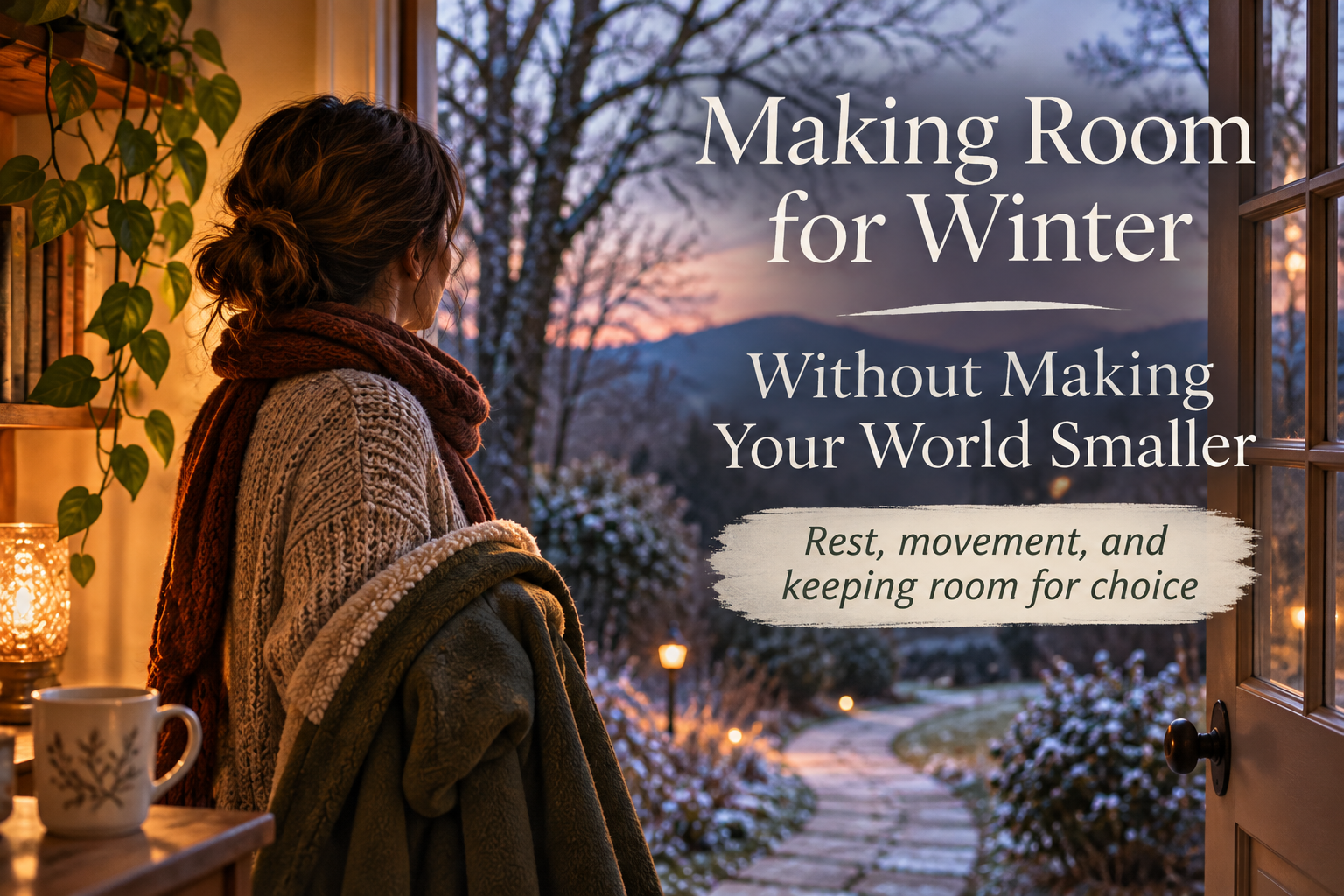
A gentle conversation with Freeze about rest, movement, and choice
There is something about the time change that can make the evening feel suddenly smaller.
A few weeks ago, there may have been enough daylight left after work to take a walk, run an errand, head to a class, or simply spend a little more time outside. Then the clocks change, darkness starts arriving before the day feels finished, and the cold seems to add its own invitation:
Maybe we should just stay in.
Sometimes that invitation is exactly what we need. Rest matters, too.
But what about those times when one part of you knows that continuing to move, engage, and get out into the world would probably be helpful—and another part seems to have planted both feet firmly inside the front door?
Rather than immediately calling that laziness or trying to push through it, this might be an invitation to wonder about something else:
Could there be a little Freeze energy here?
For women with ADHD, this seasonal shift may have a few extra layers. A transition that changes the familiar cues of the day can require some recalibration. The activity that felt fairly accessible when you left work in daylight may suddenly feel like a much bigger lift when that same hour is dark and cold.
Add a nervous system already carrying the demands of the day, and I know I want to keep moving and I really don't want to move can exist at exactly the same time.
Freeze can be easy to confuse with simply wanting to escape or avoid something. But I tend to think of Freeze a little differently.
There can actually be quite a bit of energy happening on the inside while things remain pretty still on the outside. You may be thinking about going. You may even want to go. You may know that movement would probably feel good once you got started.
And still—you don't move.
Sometimes Freeze seems to carry a kind of Plan B energy: For now, staying right here feels safer than finding out what happens if I move.
That response may have good reason for being there. So rather than immediately trying to override it, what if we got curious about what Freeze is trying to do for you?
What Does Freeze Have to Say?
You might start simply by imagining that the part of you wanting to stay put gets to have a voice.
What does Freeze have to say about going out tonight?
Maybe the answer is, It's dark out there. Or, It's cold. Or, I'm tired and I don't want one more thing asked of me today.
There doesn't have to be a right answer. The point is to listen long enough to find out what is actually there.
Then you might wonder:
What is Freeze trying to do for me by telling me this?
Maybe it is trying to keep you comfortable. Safe. Warm. Unhurried. Protected from one more demand.
If something begins to fit, see if you can put it into words:
Freeze is trying to help me ________.
And before deciding whether staying completely still is the best way to accomplish that, there may be room for one more question:
Is what Freeze is trying to do for me worthy of some appreciation?
You don't have to agree with everything Freeze wants you to do in order to appreciate what it may be trying to do for you.
That distinction matters.
Understanding the intention doesn't require handing over the steering wheel.
What Kind of Movement Feels Approachable?
Once Freeze has had a chance to be heard, the next question doesn't have to be:
Okay, how do I make myself go anyway?
Instead, you might ask:
Given what I know now, what kind of movement feels approachable enough?
That answer may look very different from the original plan.
Maybe the long evening walk becomes ten minutes outside before the temperature drops further. Maybe you move the walk to lunchtime tomorrow. Maybe you put on music and move around the house. Maybe you drive to the store instead of deciding that the errand can wait indefinitely. Maybe tonight really is a night for rest—and you intentionally choose when you would like to move again.
The goal isn't to prove to Freeze that there was nothing to worry about.
It's to see whether the two of you can find one sufficiently safe way to move.
Sometimes the gentlest movement is enough to remind your system:
I'm not trapped here. I still have choices.
And over time, those small choices can matter.
Because when staying still becomes the automatic answer each time something feels dark, cold, uncertain, or uncomfortable, our range of motion can gradually become smaller without us necessarily noticing it.
The invitation isn't to force that range back open all at once.
It's to stay curious about the smallest movement that keeps some room for choice.
Resting or Getting Stuck?
There may be something genuinely nourishing about allowing our rhythms to change with the season.
Earlier sunsets can invite us home. Cold evenings can make blankets, warm drinks, slower routines, and an earlier settling-in feel particularly welcome.
Choosing that isn't the same thing as being stuck.
Maybe the distinction worth noticing is whether you are choosing to draw inward or discovering that your world has become smaller than you intended.
[INTERNAL LINK #1: Link “your world has become smaller than you intended” to the When the Outside World Gets Loud blog.]
You might even check in from time to time:
Am I resting because rest is what I need right now?
Or is there something I would actually like to be doing that has started to feel increasingly difficult to move toward?
Sometimes a smaller range of physical movement can quietly become a smaller range of social movement, too. We go out a little less. We see fewer people. Over time, having very little contact outside of our familiar circle can begin to feel normal.
And when we have fewer experiences reminding us that there are places where we fit, moments of awkwardness, neutral responses, or disappointing interactions may begin to carry more weight than they otherwise would.
For women with ADHD who already experience rejection sensitivity or RSD, that can become an especially tender loop: the less connected we feel, the easier it may become to notice evidence that we don't belong—and the harder it can feel to move toward connection again.
That doesn't mean the answer is to force yourself out the door.
If rest is what you need, perhaps you can let yourself enjoy the rest without turning it into something that needs to be fixed.
And if you notice that your world is becoming smaller than you actually want it to be, you don't necessarily have to force yourself all the way back into your old routine either.
You can listen to Freeze.
You can appreciate what it is trying to do.
And then you can wonder together:
What is the gentlest movement that feels possible from here?
Maybe winter doesn't require us to choose between pushing ourselves through the darkness and disappearing into it.
There may be room for something in between—a season with more rest, different rhythms, and enough continued movement to remind ourselves that we still have choices.
Frequently Asked Questions
How can I tell the difference between needing rest and feeling stuck in Freeze?
Sometimes both can look like staying home, slowing down, or deciding not to do something you had planned. The difference may be less about what you are doing and more about what you notice inside.
Rest can feel like a responsive choice: This is what I need tonight.
Freeze may feel more like: Part of me wants to move, but I can't quite get myself to do it.
Rather than trying to label the experience perfectly, you might simply notice whether your choices still feel available to you. If your world is becoming smaller than you actually want it to be, that may be an invitation to get curious about what is making movement feel difficult.
How can rejection sensitivity or RSD affect women with ADHD when they feel less socially connected?
For some women with ADHD, rejection sensitivity can make disappointing, ambiguous, or neutral social interactions feel particularly charged. When you have also been spending less time around other people, there may be fewer everyday experiences reminding you that you do belong, that relationships can tolerate awkward moments, and that one interaction doesn't necessarily tell the whole story.
That can make withdrawing further feel tempting.
Instead of forcing connection, it may be helpful to notice when your social world is becoming smaller than you want it to be and consider what kind of connection feels approachable from where you are now.
How might EMDR therapy help when I understand a pattern but still feel stuck in it?
Sometimes insight isn't the missing piece. You may already understand why you respond a certain way and still notice your nervous system reacting as though an old danger, rejection, or expectation is happening again in the present.
EMDR therapy can offer a way to explore earlier experiences that may still be contributing emotional intensity to current situations. When appropriate, that work can be combined with present-focused resources and parts-informed exploration so that understanding the pattern isn't the endpoint—you can also begin to experience more room for choice in how you respond now.
When You Want More Room to Move
Sometimes the places where we feel stuck aren't really about knowing what we should do next. We may already know.
The harder part can be understanding what makes movement feel difficult—and learning how to respond to the parts of us that are trying to keep us safe without allowing our choices to become smaller and smaller.
In my work providing EMDR therapy for women with ADHD in North Carolina, we can make room to explore those patterns with curiosity.
Together, we can notice what your nervous system may be responding to, strengthen the resources that help you feel grounded in the present, and, when appropriate, use EMDR to work with earlier experiences that may still be adding intensity to what is happening now.
The goal isn't to make yourself move faster.
It's to have more freedom to choose when you want to rest—and when you're ready to move.
If you're ready to explore what that could look like for you, I invite you to reach out for a consultation.
