When Old Grief Resurfaces: EMDR for ADHD Women in North Carolina
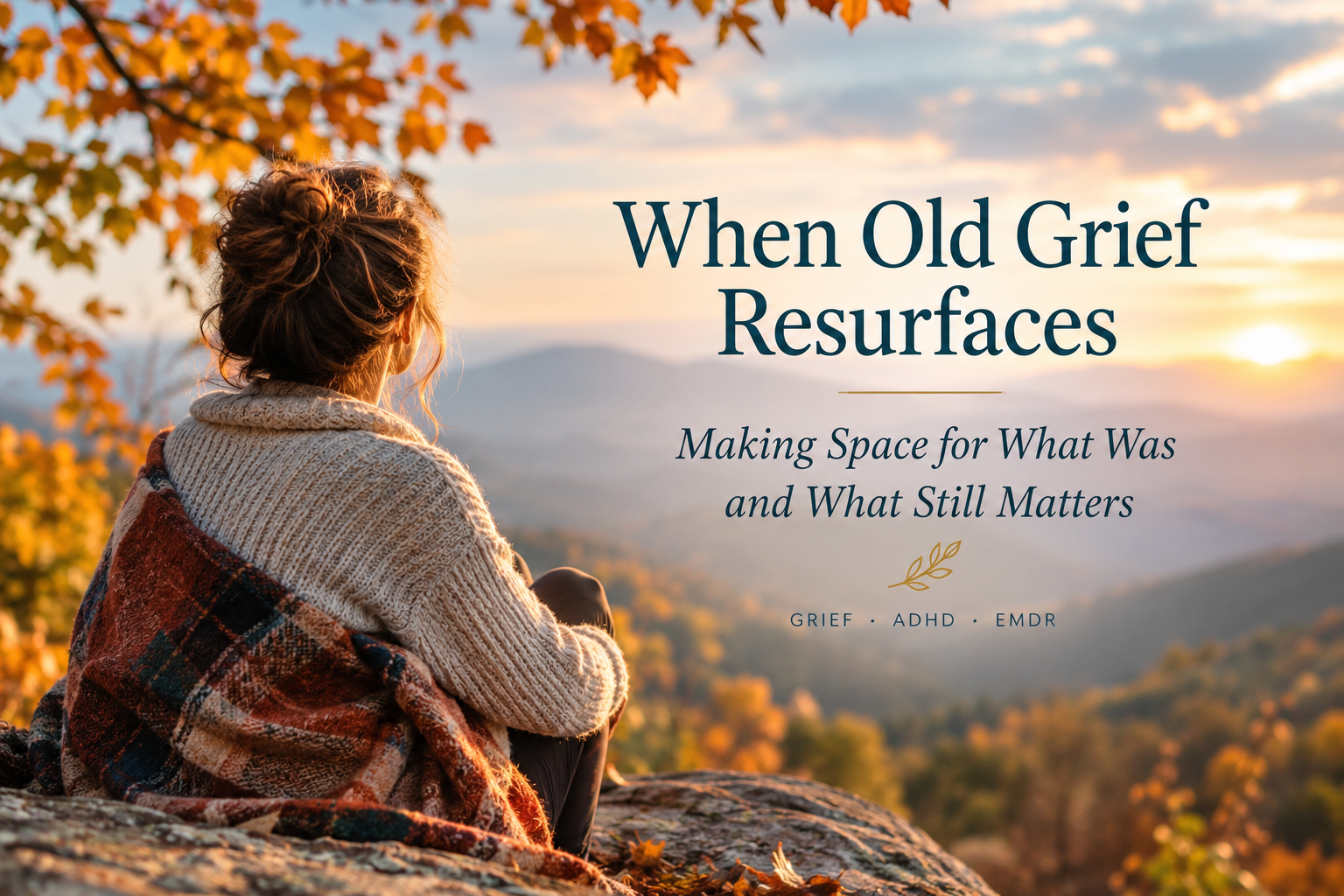
When contemplating grief this fall, a loss that happened long ago may surface.
You may feel guilt for moving too quickly away from the memory of what was. You may feel frustration or embarrassment for feeling too stuck in the memory. You may find yourself anticipatorily bracing for others to misunderstand your honest pain as evidence that you are “too much” for still caring so deeply about a loss that happened decades ago.
And that anticipation of being misunderstood can leave you feeling even more alone in your grief.
For some women with ADHD, grief can become tangled with the experience of emotional intensity and a familiar question: Is the way I am feeling this somehow too much?If you've spent years being misunderstood because of the intensity of your emotions, even grieving can become something you learn to monitor, minimize, or hide.
But what if an old loss resurfacing doesn't mean you've gone backward?
What if the pain is becoming visible again because your life has grown large enough—and you have enough perspective now—to finally make room for what was never fully processed?
We Don't Always Have the Resources When the Loss Happens
Sometimes, the resources we have at the time of a loss are only a fraction of what we may eventually need as we mature.
For example, a child who is aware of a major loss may not have the brain development necessary to fully process all the implications of that loss at the time.
A young adult trying to train for and begin supporting herself may not have the time, energy, or perspective needed to come to total grips with the paths life took her on—and the paths that might have been different.
Sometimes, we aren't even aware that what happened to us was out of the norm until we get out on our own and discover that other people's paths were completely different.
For women with ADHD, especially those who have spent years using enormous amounts of energy to keep up with expectations, there may have been very little capacity left over for processing what was happening underneath the surface.
This can be one reason that experiences connected to ADHD and trauma become easier to recognize later in life. With more perspective, we may begin to see connections between old experiences, emotional patterns, shame, rejection sensitivity, and the ways we learned to adapt.
Thank goodness our brains have ways of protecting us in those moments, allowing things to take a back seat until the time, energy, and resources are available for unpacking.
Maybe you weren't failing to process it.
Maybe you were surviving it.
When Midlife Gives Us a Different Perspective
When we reach midlife, it is very normal to reach a point of perspective in which your mind, body, and heart become fully aware that the emotional weight of past losses is too dang heavy to keep carrying around for the second half of the journey.
After years of adapting, over-functioning, masking, or simply pushing through, many women reach a point where they begin to recognize just how much energy their old ways of coping have required.
For women with ADHD, this realization can be especially significant. A lifetime of feeling different, misunderstood, emotionally intense, or out of step with expectations can leave a lot of experiences sitting quietly in the background while daily life demands our attention.
It's also normal at this stage to come to grips with the fact that our time on this earth is not actually infinite. Choices need to be made intentionally, or life is going to choose for us.
And sometimes that realization changes the question.
Instead of How do I keep carrying all of this?
we begin asking:
What can I put down?
What still matters?
What do I want to make room for now?
At this point, it becomes imperative for all of our systems to take careful stock of our hopes and dreams, lighten our load of what can go, and lean further into what is truly important to our authentic selves.
Sometimes we don't need to go back because we are stuck in the past.
Sometimes we go back because we finally have enough resources in the present to look at something differently.
Perhaps This Will Help
Imagine your pain at the time of loss in the shape of a ball and your life as a square.
At the time of your loss, that ball may seem to take up 99%, if not all, of the space inside that square. Every nook and cranny of your life scrapes up against that grief at a constant pace.
Over time, the size of your life increases as you grow and new chapters enter your life.
The square, representing your life, becomes larger, while the size of the pain may remain much the same.
Now there is more room between the borders of your life and that pain.
The ball doesn't necessarily have to become smaller for your life to become larger.
The contact between the ball and the boundaries of your larger-shaped life still happens, even though it may happen less often.
And when that contact does happen, the grief can feel surprisingly immediate—even if the loss happened years or decades ago.
That doesn't necessarily mean you are back where you started.
It may simply mean that you have touched the place where the loss still lives.
When Pain and Meaning Live Side by Side
Each moment of contact, whether the loss is recent or several years old, can carry a timeless quality to its intensity. At the same time, that pain can be a confirmation of just how special the connection was—and still is—for you.
One of the most healing moments of my own grief journey has been hearing that.
The pain doesn't have to be evidence that something is wrong with you.
Sometimes pain is evidence of meaning.
The depth of what hurts can be intertwined with the depth of what mattered.
And perhaps this is one of the places where healing becomes less about making the ball disappear and more about changing the amount of space it occupies in your life.
The memory can remain.
The love can remain.
The meaning can remain.
And there can still be room for you.
Making More Room With EMDR
This is one of the reasons approaches such as EMDR therapy for women with ADHD can be meaningful when old experiences continue to carry a strong emotional charge.
EMDR isn't about erasing a memory or making something that mattered stop mattering.
Rather, EMDR can help support the brain's natural processing of experiences that still feel emotionally present, so that remembering does not have to carry quite the same intensity in the here and now.
For women seeking EMDR for ADHD women in North Carolina, this work may be particularly meaningful when old experiences have become tangled with years of feeling misunderstood, masking, rejection sensitivity, shame, or the belief that their emotional responses are simply “too much.”
The goal isn't to make you care less.
It may be to create enough internal space that you can care deeply without the pain having to fill the entire square.
The Yin and Yang of Grief
Like a knobby trunk of a solid old oak tree.
As you lean into it, the discomfort exfoliates and awakens you to just how upright and supported you actually are because of it.
The yin and the yang of it.
Each side couldn't exist without the other.
Perhaps grief can be like that, too.
The ache and the love.
The loss and the meaning.
The tenderness and the strength that grew around it.
Sometimes the very places that hurt can point us toward what needs our attention now.
And sometimes nature reminds us of this without saying a word.
The availability of a spacious sky to look up into can remind us that we aren't actually alone in anything we are struggling with—as long as we're willing to stay curious about what is needed.
An old loss resurfacing doesn't mean you've gone backward.
Sometimes it means your life has grown large enough to finally make room for what was.
And perhaps there is more room now for what still matters, too.
FAQ
Can grief resurface years or even decades after a loss?
Yes. Grief doesn't always follow a predictable timeline. A loss may feel different at different stages of life as your perspective, circumstances, relationships, and capacity for processing change.
Why can an old loss suddenly feel so painful again in midlife?
Midlife can bring new perspective about what has mattered, what has been carried for years, and what you want the next part of your life to hold. Sometimes that perspective brings old grief back into awareness—not because you've gone backward, but because you now have more room to understand what happened.
Can ADHD affect how women experience grief?
Women with ADHD may experience emotional intensity, rejection sensitivity, shame, masking, and feeling misunderstood alongside their grief. These experiences can sometimes make grief feel more complicated or isolating.
Can EMDR help with grief?
EMDR may be helpful when a loss or other experience continues to carry a strong emotional charge. EMDR does not erase a meaningful memory or make a person care less. The goal is to help process experiences that remain distressing so they may feel less overwhelming in the present.
Is EMDR for ADHD women available in North Carolina?
Yes. EMDR can be incorporated into therapy for women with ADHD in North Carolina when it is clinically appropriate. A therapist can help determine whether EMDR fits your particular experiences, needs, and goals.
Making Room for What Comes Next
If an old loss has resurfaced and you're wondering why it feels so present again, you don't have to figure out what it means—or what to do with it—alone.
Sometimes the next step isn't about letting go of something that mattered. It's about creating enough space to carry what mattered differently.
If you're a woman with ADHD in North Carolina who is ready to explore that possibility, EMDR may be one path toward making more room for what matters now.
You’re welcome to schedule a 15-minute consultation to talk about what you're experiencing and whether working together might be a good fit.
